Capital Reserve Planning Guide: Forecasting Building Replacement Costs
A capital reserve forecast is a long-range financial planning tool that predicts when major building components will need repair or replacement and estimates how much money must be set aside each year to cover those future costs. For commercial property owners, condominium boards, and asset managers across Alberta, this forecast transforms unpredictable, budget-wrecking expenses — a failed rooftop unit, a crumbling parking structure, an aging elevator — into manageable, planned line items. Property owners who commission commercial property inspections in Edmonton as part of their capital planning process gain the physical condition data that makes an accurate reserve forecast possible, rather than relying on generic industry averages that don't reflect their building's actual wear patterns, climate exposure, or maintenance history.
Need a Commercial Property Inspection or Property Condition Assessment?
Brookstone Inspection offers Commercial Property Inspection or Property Condition Assessment. Request a Commercial Property Inspection or Property Condition Assessment Quote
This guide explains how capital reserve forecasting works, what standards govern the process, how Alberta's climate affects replacement timelines, and how building owners can use these forecasts to protect asset value, satisfy lender requirements, and avoid special assessments.
Key Takeaways
- A capital reserve forecast estimates remaining useful life and replacement cost for every major building system, typically spanning a 20 to 30 year planning horizon.
- Reserve fund studies are legally required for many Alberta condominium corporations under the Condominium Property Act and are strongly recommended for all commercial property owners.
- Accurate forecasts depend on a physical condition assessment — a Property Condition Assessment (PCA) per ASTM E2018 provides the component-level data reserve studies require.
- Alberta's freeze-thaw cycles, snow loads, and temperature swings shorten the useful life of roofing, exterior envelope, and parking structure components compared to milder climates.
- Underfunded reserves are a leading cause of special assessments, deferred maintenance, and reduced property values during commercial real estate transactions.
- Lenders, insurers, and prospective buyers increasingly request current reserve fund studies or capital needs assessments before financing or closing a deal.
What Is a Capital Reserve Forecast and Why Does It Matter?
A capital reserve forecast — also called a reserve fund study, capital needs assessment, or long-term capital plan — is a documented projection of a building's major capital expenditures over a defined future period, paired with a funding plan to meet those costs without relying on emergency loans or special assessments.
Unlike an operating budget, which covers day-to-day expenses like cleaning, utilities, and minor repairs, a capital reserve forecast focuses exclusively on major, non-recurring replacements: roof systems, HVAC equipment, elevators, parking structures, building envelope components, and life safety systems. These are the big-ticket items that, left unplanned, force boards and owners into reactive crisis spending.
The Financial Purpose of Reserve Planning
The core function of a capital reserve forecast is risk transfer from the future to the present in small, predictable increments. Instead of facing a $400,000 roof replacement bill with no warning, a well-funded reserve plan has been collecting proportional contributions for 15 years leading up to that expense. This matters for several stakeholder groups:
- Condominium boards — legally obligated in many cases to maintain adequate reserves and disclose funding status to owners and prospective buyers.
- Commercial building owners — need to protect net operating income and avoid capital calls that damage investor relationships.
- Lenders and insurers — increasingly require evidence of adequate capital planning before underwriting mortgages or renewing coverage on aging assets.
- Buyers and their advisors — use reserve studies alongside Pre-Purchase Due Diligence Inspection findings to negotiate price or repair credits.
How Reserve Forecasts Differ from Property Condition Assessments
A Property Condition Assessment (PCA), conducted according to ASTM E2018, documents the current physical condition of a building's systems at a single point in time — typically during a transaction. A capital reserve forecast takes that condition data and extends it forward across decades, layering in remaining useful life estimates, inflation-adjusted replacement costs, and funding models.
In practice, the two are complementary rather than competing tools. Many Alberta property owners commission a PCA first to establish a defensible baseline of conditions, then use that report as the foundation for an ongoing capital reserve forecast that gets updated every three to five years. For a detailed breakdown of what is included in a Reserve Fund Study, see our guide on What's Included in a Reserve Fund Study
How Do You Calculate Building Replacement Costs?
Calculating accurate replacement costs requires combining physical inspection data with current construction pricing, inflation projections, and component-specific life expectancy tables — not generic per-square-foot rules of thumb.
Step 1: Inventory Every Major Capital Component
The forecasting process begins with a comprehensive inventory of every building system with a finite useful life exceeding one year and a replacement cost exceeding a defined threshold (commonly $5,000 to $10,000, depending on the property). Typical categories include:
- Roofing systems (membrane, shingle, or metal)
- HVAC equipment (rooftop units, boilers, chillers, make-up air units)
- Building envelope (cladding, windows, sealants, waterproofing)
- Parking structures and paved lots
- Elevators and vertical transportation
- Electrical distribution and emergency generators
- Plumbing systems and domestic water heaters
- Fire and life safety systems
- Interior finishes in common areas
- Site amenities (fencing, signage, landscaping infrastructure)
Step 2: Estimate Remaining Useful Life
For each component, an inspector or engineer estimates remaining useful life (RUL) by comparing the installation date, observed condition, maintenance history, and manufacturer-rated service life against known deterioration patterns. A rooftop membrane rated for 20 years by the manufacturer might show only 12 years of remaining life if installation records, ponding water evidence, or granule loss suggest accelerated aging.
Step 3: Apply Current and Escalated Replacement Costs
Replacement cost estimates should reflect current market pricing for materials and labour in the specific region — Edmonton, Calgary, and Red Deer pricing can vary meaningfully due to labour market conditions and contractor availability. Forecasts then apply an inflation escalation factor (commonly 2.5% to 4% annually) to project the cost at the actual anticipated replacement year, not today's dollars.
Step 4: Model Multiple Funding Scenarios
Once costs and timing are established, the forecast models funding approaches — typically a component-based "cash flow" method that spreads contributions evenly while adjusting for known upcoming expenditures, versus a "straight-line" method that pools funds without earmarking specific components. Most Alberta reserve fund studies favor the component/cash-flow method because it produces a more realistic, less volatile contribution schedule.
An Opinion of Cost Report can supplement this process by providing independent, itemized cost estimates for specific anticipated repairs, which strengthens the credibility of the overall forecast when presented to boards, lenders, or auditors.
What Standards Govern Capital Reserve Studies in Alberta?
Capital reserve planning in Alberta operates at the intersection of provincial condominium legislation, industry inspection standards, and professional engineering practice, with no single unified national standard but several converging frameworks.
Condominium Property Act Requirements
Alberta's Condominium Property Act and its associated regulations require many condominium corporations to conduct a reserve fund study and adopt a reserve fund plan, with studies typically required to be updated at least every five years or sooner if there are significant changes to the property. Boards that fail to maintain adequate reserves can face legal exposure to owners, particularly if a special assessment results from foreseeable underfunding.
Inspection and Assessment Standards
While the Condominium Property Act sets the legal requirement, the underlying condition data is best gathered using recognized inspection methodologies:
- ASTM E2018 — the U.S. and widely-referenced Canadian standard for Property Condition Assessments, providing a structured methodology for documenting building system conditions and estimated remaining useful life.
- CCPIA ComSOP — the Certified Commercial Property Inspectors Association's Commercial Standards of Practice, which establishes scope-of-work protocols for commercial building inspections that feed into capital planning. Learn more at ccpia.org.
- APEGA guidelines — where structural, mechanical, or electrical systems require engineering judgment beyond visual inspection, Alberta requires that assessments be signed off by professionals registered with the Association of Professional Engineers and Geoscientists of Alberta.
Alberta Building Code Considerations
Reserve forecasts must also account for code-driven upgrades. Older buildings undergoing major component replacement — such as a full roof or electrical panel replacement — may trigger requirements to bring related systems up to current Alberta Building Code standards, which can increase replacement costs beyond simple like-for-like pricing. Our detailed guide to Alberta Building Code Requirements for Commercial Properties explains how these triggers work and what owners should budget for.

How Does Alberta's Climate Affect Reserve Fund Timelines?
Alberta's climate is one of the most significant variables in accurate reserve forecasting, because freeze-thaw cycling, extreme temperature swings, and heavy snow loads accelerate deterioration of specific building components well beyond manufacturer-rated service life assumptions developed for milder climates.
Freeze-Thaw Damage to Concrete and Parking Structures
Edmonton, Calgary, and Red Deer all experience dozens of freeze-thaw cycles each winter, during which moisture trapped in concrete pores expands and contracts, gradually causing spalling, cracking, and rebar corrosion. Parking structures and exposed concrete elements in Alberta commonly show measurable deterioration 20% to 30% faster than comparable structures in coastal or southern climates, making conservative remaining-useful-life estimates essential for these components.
Roofing System Degradation
Roofing membranes in Alberta face an unusual combination of stresses: intense summer UV exposure, rapid temperature drops, heavy snow and ice accumulation, and wind uplift during Chinook events. A membrane roof rated for a 20-year service life in moderate climates may realistically deliver 15 to 18 years in Edmonton or Calgary conditions, particularly if drainage design is marginal or maintenance has been inconsistent.
HVAC Equipment Cycling Stress
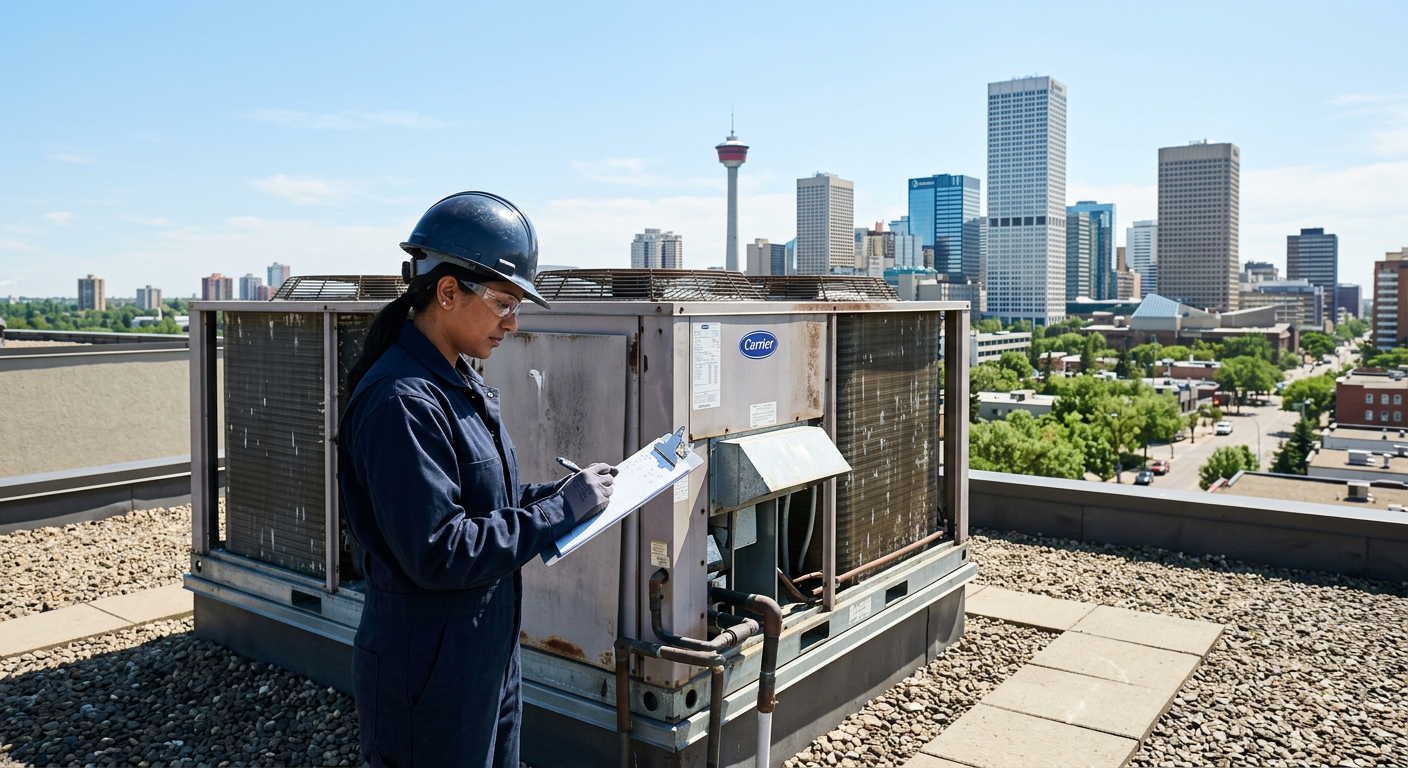
Rooftop HVAC units in Alberta cycle through extreme operating ranges — from -30°C heating demand in January to +30°C cooling demand in July — placing more mechanical stress on compressors, coils, and controls than equipment in more temperate regions experiences. This wider seasonal load swing is a key reason reserve forecasts for Alberta properties should generally apply shorter remaining-life estimates for mechanical equipment than national averages suggest.
Regional Variation Within Alberta
While Edmonton, Calgary, and Red Deer share broadly similar climate challenges, there are regional nuances. Calgary's Chinook winds create rapid, repeated freeze-thaw transitions that can be harder on building envelopes than Edmonton's more sustained cold periods, while Red Deer properties often see comparable snow load demands with somewhat less wind-driven envelope stress. An accurate capital reserve forecast should reflect these local conditions rather than applying a single provincial average.
What Building Components Need the Most Frequent Capital Planning?
Certain building systems consistently account for the largest share of capital reserve expenditures and therefore deserve the most rigorous forecasting attention.
Roofing Systems
Roofing is typically the single largest line item in most commercial reserve studies, both because of replacement cost per square foot and because Alberta's climate compresses expected service life. Reserve forecasts should track membrane type, installation date, warranty status, and recent repair history in detail.
Mechanical and Electrical Systems
HVAC equipment, boilers, and electrical distribution infrastructure represent the second major category, and often the most technically complex to forecast accurately because different components within the same system (compressors versus ductwork versus controls) have vastly different service lives. A dedicated Mechanical & Electrical Systems Audit provides the granular, component-level data needed to forecast this category with confidence rather than treating an entire HVAC system as a single line item.
Building Envelope and Structural Elements
Cladding, windows, sealants, and waterproofing systems degrade gradually and are frequently underfunded because failures are less dramatic than a mechanical breakdown until water infiltration causes secondary damage. Common commercial building deficiencies found during inspections frequently include envelope issues that, left unaddressed, escalate rapidly in cost.
Parking Structures and Site Infrastructure
Parking structures, asphalt lots, and underground utilities are often overlooked in reserve planning because they deteriorate slowly and out of daily sightlines, yet full parking structure rehabilitation can rival roofing costs on a per-project basis.
Elevators and Life Safety Systems
Elevator modernization, fire alarm panel replacement, and sprinkler system upgrades are less frequent but high-cost events that require long lead times for planning, procurement, and code compliance review — making early identification in the forecast critical.

How Do You Build a Realistic Funding Plan?
A realistic funding plan translates the replacement cost forecast into an actual annual contribution schedule that avoids both underfunding risk and unnecessarily high fees that erode competitiveness or investor returns.
Assessing Current Reserve Adequacy
The first step is calculating a percent funded ratio — current reserve balance divided by the theoretical fully-funded balance for the property's age and component inventory. Industry benchmarks generally classify reserves as:
- Strong: 70% funded or higher
- Adequate: 30% to 70% funded
- Weak/at-risk: Below 30% funded, with elevated special assessment risk
Choosing a Contribution Escalation Strategy
Because construction costs have risen faster than general inflation in recent years across Edmonton commercial inspection services territory and throughout Alberta, funding plans typically build in annual contribution increases of 3% to 6% rather than flat contributions, smoothing the transition toward full funding over a 10 to 15 year period rather than requiring an immediate, disruptive fee jump.
Stress-Testing Against Multiple Scenarios
A sound capital reserve forecast tests at least three scenarios: baseline (expected costs and timing), accelerated deterioration (components failing earlier than projected, common in Alberta's climate), and cost escalation (construction inflation exceeding historical averages). Boards and owners who plan against the accelerated scenario are far less likely to face emergency special assessments.
Integrating Findings from Physical Inspections
Funding plans are only as good as the condition data behind them. Reviewing how to read your commercial inspection report helps board members and asset managers translate inspector findings — deficiency ratings, estimated remaining life, urgency classifications — directly into forecast line items rather than treating the inspection report and the financial plan as separate, disconnected documents.
How Often Should a Capital Reserve Forecast Be Updated?
Capital reserve forecasts should be substantively updated every three to five years, with lighter interim reviews annually to track actual spending against projections and adjust for any newly identified deficiencies.
Triggers for an Earlier Update
Beyond the standard cycle, several events should trigger an immediate forecast review:
- A major unplanned repair or failure that wasn't in the original forecast
- A significant capital improvement or system replacement completed ahead of schedule
- Acquisition or disposition of the property, requiring updated due diligence
- A lender or insurer request tied to refinancing or renewal
- Discovery of previously undocumented deficiencies during a routine inspection
Why Static Forecasts Fail
A forecast built once and never revisited becomes progressively less reliable as actual deterioration rates, construction costs, and interest rate environments diverge from original assumptions. Properties relying on outdated reserve studies are disproportionately represented among special assessment cases across Alberta, reinforcing why ongoing physical inspection and financial reforecasting should be treated as a continuous cycle rather than a one-time project.

How Do Reserve Forecasts Affect Property Value and Transactions?
Capital reserve adequacy has a direct and quantifiable impact on commercial property value, financing terms, and negotiation leverage during acquisitions and dispositions.
Buyer and Lender Due Diligence
Sophisticated buyers and their lenders routinely request current reserve fund studies or capital needs assessments as part of due diligence, using underfunded reserves as leverage to negotiate purchase price reductions, escrow holdbacks, or seller-funded repair credits. Our Due Diligence Inspection Checklist for Commercial Buyers outlines exactly what documentation buyers should request, including reserve studies alongside physical inspection reports.
Impact on Net Operating Income Projections
For income-producing properties, projected capital expenditures directly affect forward-looking net operating income calculations used in valuation models. A building with a well-documented, adequately funded reserve plan presents lower perceived risk than a comparable property with no forecast or a known funding shortfall, which can translate into a measurably higher achievable sale price or capitalization rate advantage.
Lease Structure Considerations
For properties operating under triple net lease structures, capital reserve planning interacts closely with lease terms governing which party bears responsibility for major capital replacements versus routine maintenance. A Triple Net Lease Assessment helps clarify these boundaries and ensures the capital forecast aligns with actual landlord versus tenant financial obligations.
Working with Professional Inspectors and Engineers
Because capital reserve forecasts combine engineering judgment, construction cost estimating, and financial modeling, most Alberta property owners engage a combination of qualified building inspectors — often working to CCPIA ComSOP protocols — and, where structural or complex mechanical systems are involved, APEGA-registered engineers. Understanding the commercial inspection cost guide for Alberta helps owners budget appropriately for the physical inspection component of a comprehensive reserve study, which typically represents a modest investment relative to the capital expenditures it helps plan for. For ongoing management, pairing the forecast with a Maintenance Strategy Program helps extend component life and smooth out the timing of major replacements.
Property owners exploring their first capital reserve forecast, or updating an outdated one, can review our broader commercial inspection services hub to understand how a Property Condition Assessment, mechanical audit, or targeted cost opinion feeds into the overall capital planning process. Engaging professional commercial inspections early in the planning cycle ensures the resulting forecast is grounded in verified physical conditions rather than assumptions.
Commercial Property Inspections Across Alberta
Professional commercial property inspections serving 43 communities:
- Edmonton Metro: Edmonton, Sherwood Park, St. Albert
- Calgary Metro: Calgary, Airdrie
- Central Alberta: Red Deer, Lacombe
Ready to protect your investment? Book Your Inspection →
Frequently Asked Questions
What is the difference between a reserve fund study and a capital reserve forecast?
The terms are largely interchangeable in commercial and condominium property management. "Reserve fund study" is the term more commonly used in Alberta condominium legislation, while "capital reserve forecast" or "capital needs assessment" is used more broadly across commercial real estate asset management. Both describe the same core process: inventorying major capital components, estimating remaining useful life, projecting replacement costs, and modeling a funding schedule.
Is a capital reserve forecast legally required in Alberta?
Yes, for many condominium corporations. Alberta's Condominium Property Act requires eligible condominium corporations to conduct reserve fund studies and maintain reserve fund plans, typically updated at least every five years. Commercial properties held by single owners or corporations are not legally mandated to complete reserve studies in the same way, but lenders, insurers, and prudent asset management practices make them a near-universal best practice.
How much should be contributed annually to a capital reserve fund?
Annual contributions vary significantly based on building age, component inventory, and current funding status, but a common benchmark is targeting reserve fund growth sufficient to reach 70% or higher of the theoretical fully-funded balance within 10 to 15 years. Properties starting from a severely underfunded position may need contribution increases of 3% to 6% annually above inflation to close the gap without a disruptive one-time special assessment.
How does a Property Condition Assessment relate to a capital reserve forecast?
A Property Condition Assessment (PCA), typically conducted according to ASTM E2018, provides the physical condition baseline — documenting current deficiencies, component ages, and estimated remaining useful life — that a capital reserve forecast then extends into a multi-year financial projection. Many Alberta property owners commission a PCA specifically to generate reliable inputs for their reserve study rather than relying on generic industry life-expectancy tables.
How much does a capital reserve study cost in Alberta?
Costs vary based on property size, complexity, and whether a physical inspection is bundled into the engagement, but reserve studies for mid-sized commercial or condominium properties in Edmonton, Calgary, or Red Deer commonly range from a few thousand dollars for a straightforward update to a more substantial investment for a full baseline study involving detailed component inventories and on-site inspection. This cost is typically a small fraction of the capital expenditures the study is designed to plan for.
What happens if a building's reserve fund is underfunded?
Underfunded reserves force boards or owners into one of several unfavorable positions: special assessments levied against unit owners or tenants, emergency borrowing at unfavorable interest rates, or deferred maintenance that accelerates further deterioration and increases long-term costs. Underfunding is also a red flag during property sales, often triggering price renegotiation or financing complications.
Can reserve forecasts account for unexpected repairs?
A well-constructed forecast includes contingency allowances and stress-tests against accelerated deterioration scenarios, but no forecast can eliminate all uncertainty. This is why forecasts should be updated every three to five years and reviewed immediately after any major unplanned repair, ensuring the funding plan continues to reflect actual building conditions rather than outdated assumptions.